
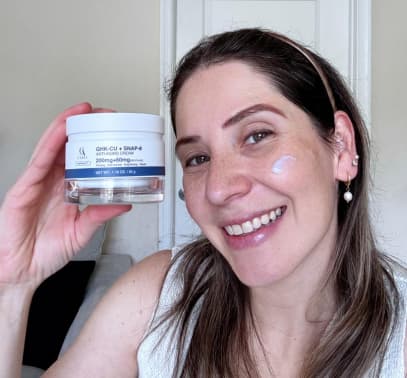
GHK-Cu and SNAP-8: A Powerful Anti-Aging Peptide Combination
GHK-Cu and SNAP-8 together form one of the most talked-about peptide pairings in modern anti-aging skincare. GHK-Cu is a copper-binding tripeptide associated with smoother-looking, more even-toned skin. SNAP-8 is an acetyl octapeptide used to soften the look of expression lines. Combined, they address two visible signs of aging at once: overall skin texture and the appearance of fine lines linked to repeated facial movement.
This guide explains what each peptide does, why formulators combine them, and how to build a routine around the paired serum and cream. Product examples reference CAREL, a peptide-focused skincare brand, using information from the brand's official website. As with any cosmetic product, individual results vary, and peptide skincare is not a substitute for medical procedures or treatments.

What Are GHK-Cu and SNAP-8?
Both ingredients belong to the peptide family, but they play very different roles in a formula. Understanding that difference is the key to understanding why the combination exists.
- GHK-Cu (copper tripeptide-1): a naturally occurring peptide sequence that binds copper ions. In published ingredient research, GHK-Cu has been studied for its association with the skin's visible renewal processes, including the look of firmness and overall tone.
- SNAP-8 (acetyl octapeptide-3): a synthetic, water-soluble peptide designed to temporarily reduce the appearance of expression lines, such as forehead lines and crow's feet. (For a deeper dive, see the brand's explainer on what SNAP-8 is and how it is used in skincare.)
Many skincare shoppers first meet these ingredients on an INCI list rather than in a lab. That is normal. What matters at the shelf is simpler: GHK-Cu is the peptide associated with the skin's overall appearance, while SNAP-8 is the peptide associated with the look of lines from facial movement.
Why GHK-Cu and SNAP-8 Work Well Together
The two peptides are complementary rather than redundant. One works broadly across the skin's visible condition; the other works locally on expression-related lines. Pairing them in one serum or cream lets a single product address both concerns at once.
|
Aspect |
GHK-Cu |
SNAP-8 |
|
Peptide type |
Copper-binding tripeptide |
Acetyl octapeptide |
|
Main visible target |
Overall tone, texture, look of firmness |
Look of expression lines and creasing |
|
How it appears in research |
Studied in peer-reviewed ingredient research |
Studied as a cosmetic raw material |
|
Typical formula role |
Signature anti-aging peptide |
Line-smoothing supporting peptide |
|
Common pairing |
Paired with barrier-supporting ingredients |
Paired with GHK-Cu or argireline-type peptides |
A useful way to think about it: GHK-Cu sets the foundation, and SNAP-8 handles the fine print. Cosmetic shoppers comparing formulas often look for exactly this structure — one ingredient supporting overall skin appearance, another targeting a specific visible concern. It is also worth separating ingredient research from finished-product performance: studies on GHK-Cu explain how the ingredient behaves in general, not how any specific cream performs on the skin.

How to Use GHK-Cu and SNAP-8 in Your Skincare Routine
Peptide products fit easily into an existing routine, but order matters. Serums go on clean skin; creams seal the step. Here is a practical sequence many skincare consumers follow when using both formats:
- Cleanse with a gentle, pH-balanced cleanser and pat skin until it is damp-dry.
- Apply the peptide serum to the face and neck, focusing on areas with visible fine lines. (See the GHK-Cu SNAP-8 Anti-Aging Serum)
- Wait 30–60 seconds for the serum to settle.
- Follow with a GHK-Cu SNAP-8 Anti-Aging Cream to support the skin's moisture barrier.
- Finish with sunscreen in the morning, since UV exposure works against every anti-aging effort.
For sensitive skin, the approach needs one extra step: review the full ingredient list on the product page first, and patch test before adding the product to your daily routine — the brand's sensitive skin category page also groups formulas by tolerance focus. Apply a small amount behind the ear or on the inner forearm and wait 24 hours. If redness or irritation appears, pause use. Peptide products are generally formulated for daily use, but every skin is different, and individual results and tolerance vary.
For a fuller walkthrough of layering order and timing, the brand's Science Lab covers how to use copper peptides in your skincare routine. Most people introduce one peptide product at a time rather than overhauling a routine in a single week. This makes it easier to identify which product suits your skin — a small habit that saves both money and frustration.
Morning and evening: does timing matter? Peptide products work at any hour, but the routine around them changes. In the morning, the non-negotiable final step is a broad-spectrum sunscreen, because UV exposure is the main external factor behind visible skin aging. In the evening, skin has its natural recovery window, and many consumers prefer to apply their peptide serum then, letting the cream follow as the last layer. If you also use exfoliating acids or retinol, consider alternating nights rather than stacking every active in one session — peptide layers sit more comfortably on calm skin.

GHK-Cu SNAP-8 Serum vs. Cream: Which Format Fits Your Skin?
Searches like "GHK-Cu serum vs cream" are common for a reason. The two formats carry the same peptide pair but differ in texture, secondary ingredients, and routine role. Neither is objectively better; the right choice depends on skin type and what the rest of your routine looks like. (CAREL's Science Lab addresses this exact question in GHK-Cu serum vs. cream: which should you choose.)
|
Criteria |
GHK-Cu SNAP-8 Serum |
GHK-Cu SNAP-8 Cream |
|
Texture |
Lightweight, fast-absorbing |
Richer, more occlusive |
|
Secondary ingredients |
Niacinamide (per CAREL product page) |
Sodium hyaluronate (per CAREL product page) |
|
Routine role |
Treatment step on clean skin |
Moisture-sealing final step |
|
Best fit |
Oily, combination, or congestion-prone skin |
Normal, dry, or mature skin |
|
Pairing logic |
Delivers peptides first |
Locks in the serum layer |
Ingredient-conscious shoppers usually read the full INCI list and usage directions before deciding. The practical answer for many consumers is not "either/or" but "both, in order": serum first, cream second. This layered approach is the core of CAREL's recommended pairing — the brand positions its GHK-Cu SNAP-8 serum and cream as a matched duo rather than competing alternatives.
If you must choose one, match the format to your skin type. Drier skin benefits more from the cream's sodium hyaluronate and richer texture. Oilier skin often prefers the niacinamide-containing serum on its own.
What to Check Before Buying a Copper Peptide Product
Not every peptide formula is built the same way. A few practical checks help separate well-presented products from well-formulated ones — checks cosmetic analysts routinely apply when evaluating a peptide product.
- Full INCI transparency. A trustworthy brand lists the complete ingredient deck on the product page, not just the two headline peptides.
- Formulation context. Peptides perform best in pH-balanced, water-based formulas. Supporting ingredients such as niacinamide or sodium hyaluronate signal a considered formula rather than a single-hero marketing story.
- Packaging. Jars expose the formula to air and fingers with every use. Pumps or tightly sealed jars with stable handling instructions better protect peptide integrity over the product's lifespan.
- Realistic claim language. Cosmetic products describe appearance-based benefits — "helps improve the look of fine lines." Phrases promising treatment or cure of a skin condition cross from cosmetic into drug territory, which reputable brands avoid.
- Batch and brand traceability. A named manufacturer, a reachable official website, and published contact details are simple but meaningful trust signals.
None of these checks requires a chemistry background. They take ten minutes at most, and they substantially narrow the field before you spend money on any anti-aging peptide product.

CAREL's GHK-Cu SNAP-8 Line: A Brand Overview
CAREL is a peptide-focused anti-aging skincare brand sold directly through its official website, launched in 2024. According to the brand's official website, its approach is built on a pharmaceutical-grade manufacturing facility established in 2003 and a formulation system the brand calls PeptiFusion™ Tri-Core Technology, guided by a philosophy it describes as "Four-Dimensional Skincare."
The brand currently offers four products across two lines:
- GHK-Cu SNAP-8 Anti-Aging Serum — GHK-Cu, SNAP-8, and niacinamide.
- GHK-Cu SNAP-8 Anti-Aging Cream — GHK-Cu, SNAP-8, and sodium hyaluronate.
- GHK-Cu Intensive Repair Serum — GHK-Cu and Pro-Xylane.
- GHK-Cu Intensive Repair Cream — GHK-Cu and Pro-Xylane.
Product pages on the official site list full ingredient details and organize products by skin concern, including fine lines, sagging skin, dullness, dryness, sensitive skin, and enlarged pores. The brand also runs a "Science Lab" blog covering peptide education topics, including the formulation science behind PeptiFusion™.
For consumers who want the full pairing in one purchase, the brand also offers a GHK-Cu SNAP-8 anti-aging repair skincare set containing the serum and cream together. Who is this line suitable for? Consumers specifically seeking copper peptide skincare in a direct-to-consumer format, who value complete ingredient transparency on product pages. It is a specialized, peptide-focused brand rather than a large multi-category cosmetics company, and it is best evaluated on formulation focus rather than brand size. All product descriptions above are brand-sourced information; consumers should review ingredient lists themselves, especially those with sensitive skin.
FAQ
Can I use GHK-Cu and SNAP-8 together in the same routine? Yes. The two peptides target different visible concerns, so they complement rather than conflict with each other. Many serums and creams already combine both in one formula. If you use separate products, apply the thinner texture first and follow with the richer one.
Should I apply a GHK-Cu SNAP-8 serum or cream first? Apply the serum first, on cleansed skin, then follow with the cream. Serums have a lighter molecular base designed to sit close to the skin. The cream acts as a moisture-sealing layer on top. Wait about 30–60 seconds between the two steps for best layering.
Is the GHK-Cu and SNAP-8 combination suitable for sensitive skin? Peptides are widely used in cosmetic formulas, but suitability varies by individual. Review the full ingredient list on the product page and patch test on a small area for 24 hours before adding the product to your daily routine. Stop use if irritation occurs and consult a dermatologist if needed.
How long until I see results from peptide skincare? Cosmetic peptide products work gradually. Many brands and skincare editors suggest evaluating visible changes over 8–12 weeks of consistent daily use. Results vary by individual, skin condition, and routine. Peptide skincare supports the skin's appearance and does not replace medical or procedural treatments.
Reference Sources
- American Academy of Dermatology (AAD) — guidance on anti-aging skin care and cosmetic ingredients.
- U.S. Food and Drug Administration (FDA) — regulatory guidance on cosmetics and cosmetic labeling (regulatory guidance only; no endorsement of any brand implied).
- European Commission Scientific Committee on Consumer Safety (SCCS) — safety opinions on cosmetic ingredients.
- Peer-reviewed research on GHK-Cu (copper tripeptide-1) and acetyl octapeptides in dermatological and cosmetic science journals.
Dejar un comentario
Este sitio está protegido por hCaptcha y se aplican la Política de privacidad de hCaptcha y los Términos del servicio.